While working with ECS-related products, I learned that in addition to the classic network, ECS supports a type of dedicated network known as Alibaba Cloud VPC. Here is an overview of VPC.
Dedicated Network (VPC):
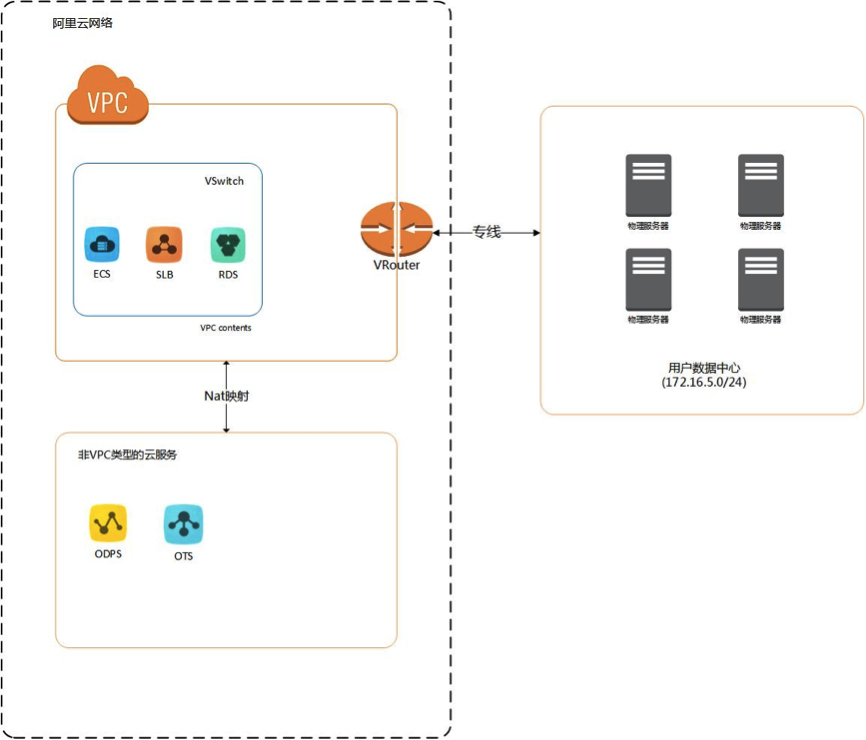
A logically isolated private network where users can customize network topology and IP addresses, supporting connections via Express Connect. It is suitable for users who are familiar with network management.
Classic Network:
IP addresses are uniformly allocated by Alibaba Cloud. Configuration is simple and convenient, making it suitable for users who require high operational ease and need to use ECS quickly.
- A single Express Connect line can only access Alibaba Cloud services within the Region corresponding to the access point.
- Routing on the Express Connect line must be static; dynamic routing protocols are not currently supported. Disaster recovery supports several schemes:
- Use IP SLA to link static routes with link status.
- Maintain two Layer 3 links simultaneously, using OpenAPI to control the routing table of the router within the VPC, while performing manual route switching on-premises.
- The IP addresses at both ends of the Express Connect line must not conflict and must be private addresses. If the user’s network consists entirely of public addresses, the client must perform NAT mapping themselves.
EIP (Elastic IP):
An Elastic IP is a public IP address that can be applied for independently. It can only be bound to ECS instances of the VPC type within the same region. It supports dynamic binding and unbinding. It is configured on the Internet Gateway device as a NAT IP, mapped to the private NIC of the ECS instance. Therefore, it cannot be viewed on the private NIC of the ECS. Currently, VPC-type ECS instances support only one private NIC.
Notes:
- VPN is a remote access technology that establishes a dedicated network over the public internet.
- Each VPC has exactly one router (VRouter), and each router can manage one routing table (RouteTable).
- Each routing table can have up to 48 route entries.
- Each VPC can create up to 24 vSwitches.
- Each VPC can accommodate up to 100 cloud product instances.
- Each account can own up to 20 Elastic IPs.